Nail shapes: all seven, and how to choose the one that suits your hands
· 6 min read
The shape of a nail changes a manicure as much as the colour does. The same red reads soft on a short oval and sharp on a long coffin. Here are the seven shapes you will be asked about, what each one does to your hands, and how to choose.
The seven shapes
Every shape below starts from the same nail. Only the free edge — the part that grows past the fingertip — changes.
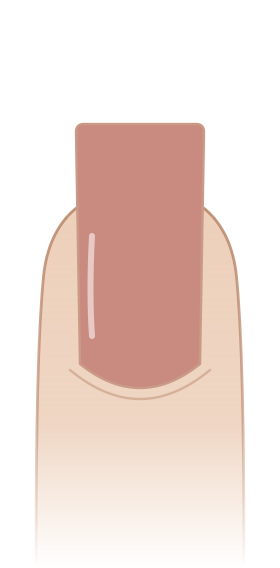
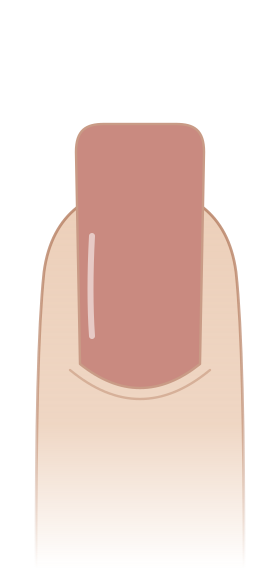
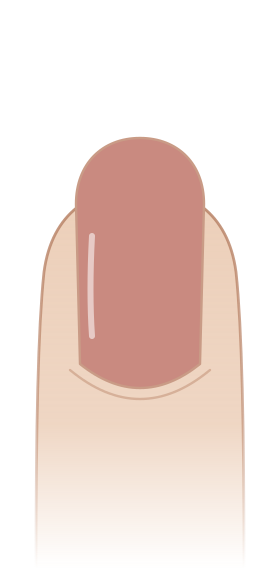
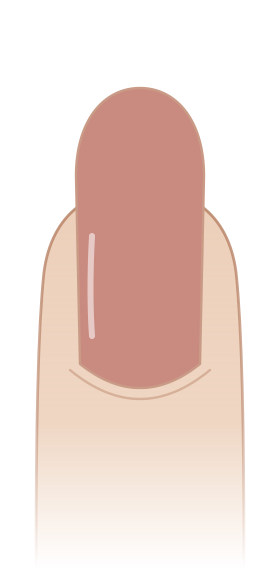
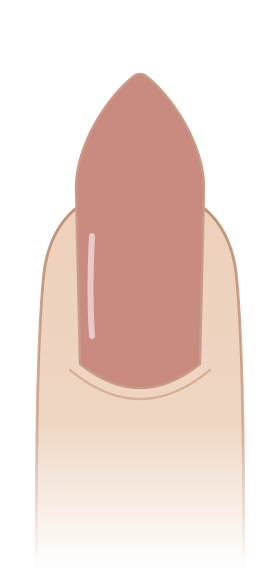
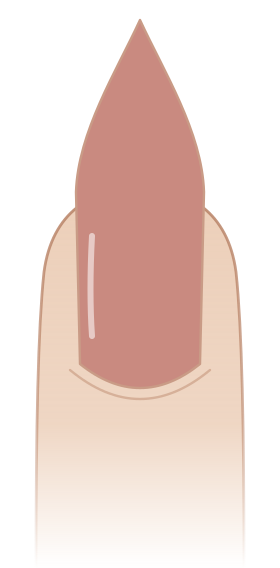
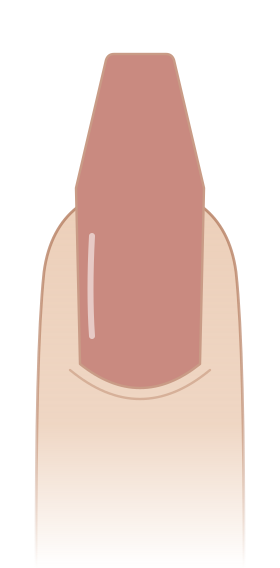
Square
Straight sidewalls and a flat free edge with sharp corners. It is a clean, graphic shape that suits long, narrow nail beds and looks especially good with a French. The corners are its weakness: they catch on things and chip first, so a square is better on nails that do not have to survive a lot of typing or washing up.

Squoval
A square with the corners softened. It keeps the flat edge but loses the snag, which makes it the most practical shape there is — strong, easy to keep, and flattering on most hands. If you are unsure, start here.

Round
A short free edge that follows the curve of the fingertip. It is the natural shape for short nails, the easiest to maintain and the hardest to break. Many people wear round nails after a break from gel or extensions while their nails grow back.

Oval
A longer, egg-shaped curve. Oval nails make fingers look longer and slimmer, and the curve spreads the stress evenly, so they are stronger than their length suggests. It is a classic for a reason.

Almond
The sidewalls taper towards a soft, rounded point, like the nut it is named after. Almond is elegant and lengthening, and suits wide nail beds well. It needs some length to work, and the narrow tip is weaker than an oval, especially on thin natural nails.

Stiletto
Almond taken to its extreme: long sidewalls that taper to a sharp point. It is a statement shape, almost always worn on extensions, because a natural nail is rarely strong enough to hold a point at that length.

Coffin, or ballerina
The sidewalls taper like an almond, but the tip is cut flat, like the toe of a ballet shoe. Coffin is one of the most requested shapes for long nails and acrylic or gel extensions. On short nails the taper has no room, so it tends to look like a narrow square.

How to choose a shape
- Look at your cuticle line. A common rule of thumb: a shape that mirrors the curve at the base of your nail tends to look most natural. A rounded cuticle suits an oval or round tip; a flatter, squarer cuticle suits a squoval or square.
- Wide nail beds: oval or almond. A tapered shape draws the eye along the nail rather than across it.
- Short fingers: oval or almond, with a little length past the fingertip. Square shapes make short fingers look shorter.
- Busy hands: squoval or round. No sharp corners and no narrow tip means fewer breaks.
- Thin or weak natural nails: keep them short and rounded while they recover. There is more on that in our guide to healthy natural nails.
How shape changes colour
A shape is a frame, and a frame changes what is inside it. Dark colours on short round nails look graphic and modern; the same dark on a long almond looks dramatic. A French tip looks delicate on an oval and architectural on a square. Pale nudes lengthen any shape; bright colours on long shapes are a lot of colour at once. This is part of why a polish rarely looks on your nails the way it looks on the swatch — the swatch tip has one shape, and it is not yours.
How to file the shape
- Start with dry nails. Wet nails are softer and tear rather than file cleanly.
- Use a fine file. A glass file or a 180–240 grit file is kind to natural nails. Coarse files are for extensions.
- File in one direction, from each side towards the centre, rather than sawing back and forth, which frays the edge.
- Shape the sidewalls first, then the tip. Look at the nail straight on, then turn your hand over and check from the palm side — it is the quickest way to see whether both sides match.
- Finish the edge. A light pass under the free edge removes the fine burr that would otherwise snag and split.
See your colour on your shape
Nail Picker works from a photo of your own hand, so the shade you try on sits on your own nails at their real length and shape. Photograph a swatch of your polish, and you see that colour on the shape you actually wear — not on a swatch tip, and not on someone else's almond nails.
